2026
Bhagalpur Tapovardhan Prakritik Chiktisa Kendra
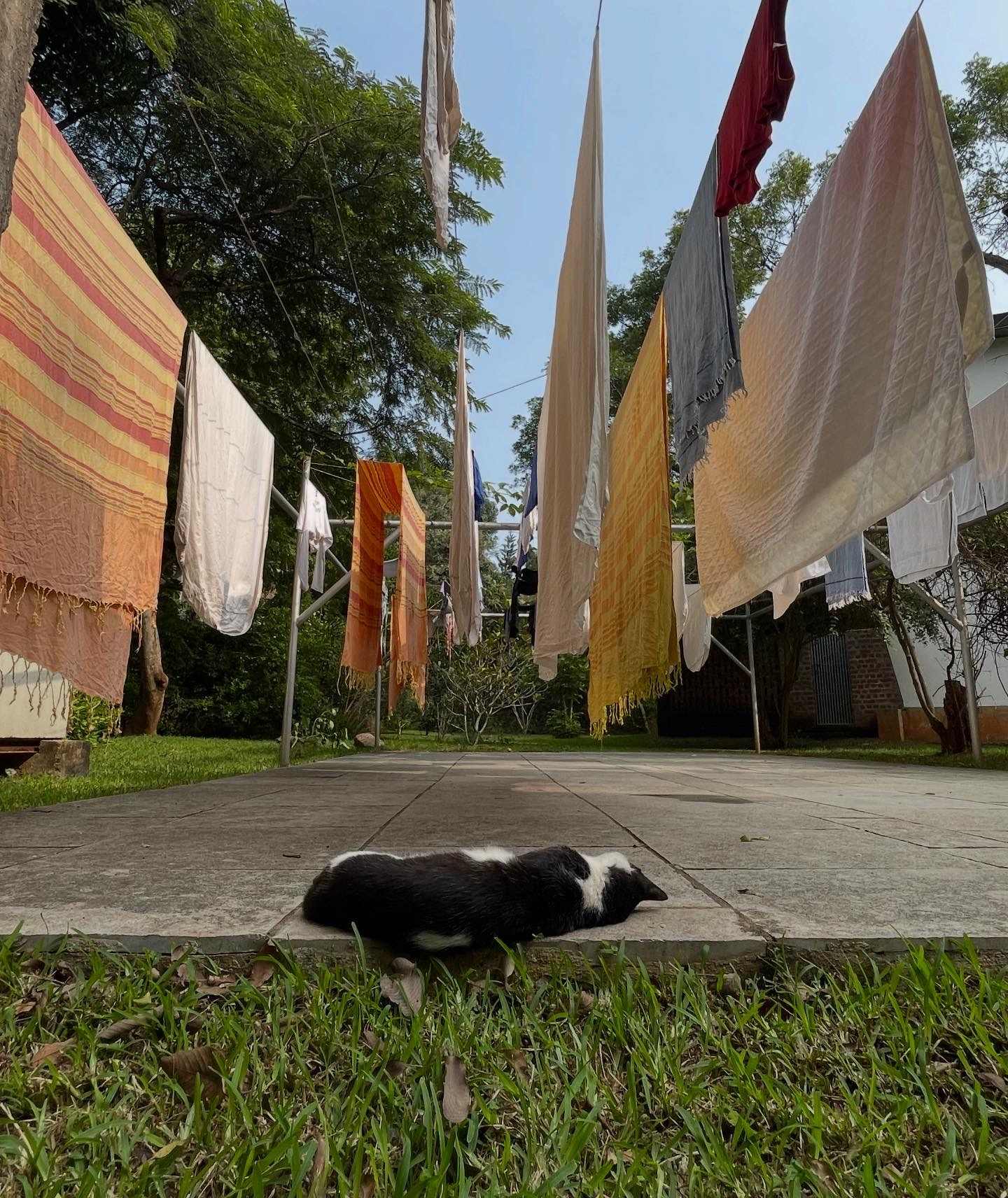
A shorter fieldwork update on Bhagalpur (I will make it longer later).
On 12 February I drove with Jeta Singh, a soldier, and a driver to Tapovardhan Prakritik Chikitsa Kendra in Bhagalpur. Jeta Singh is the son of freedom fighter and naturopath Sadanand Singh, who was asked by Gandhiji to establish the centre.
I stayed in a newly built mud house while the centre was being rapidly expanded, as Jeta had recently received government funding. Since I was the first foreigner to visit, they were quite excited and even published a short article about it in Jagran. Jeta and I spoke at length about naturopathy, nonviolent resistance, and his family’s history. On my last day, before leaving, we visited Vikramshila together.
Goddag Letter #12, Auroville with Friends
Since time flew in Auroville, I have a difficult time remembering all the events chronologically. This itself is, I think, a rather peculiar and typical experience in Auroville.
Though the chronology is a little fuzzy, the time together with the people I met is not. So for this goddag letter, I focus on these wonderful characters.
The second time in Auroville was mainly shaped by my friendship with Ilona, Shiju, Sam, and a few other people.
Ilona I met on the third day or so of my stay. We got to know each other over dinners at Center Guest House. She was so well-read, free in her attitude, and did not give a shit about what others thought of her opinions. We talked about her time in Moscow, doing reports for the BBC, how she went to Victor Frankl’s family, or travelled through Iran. We also debated lots of worldviews and life paths. Almost every evening we would walk around the Crown Road in Auroville for long talks.
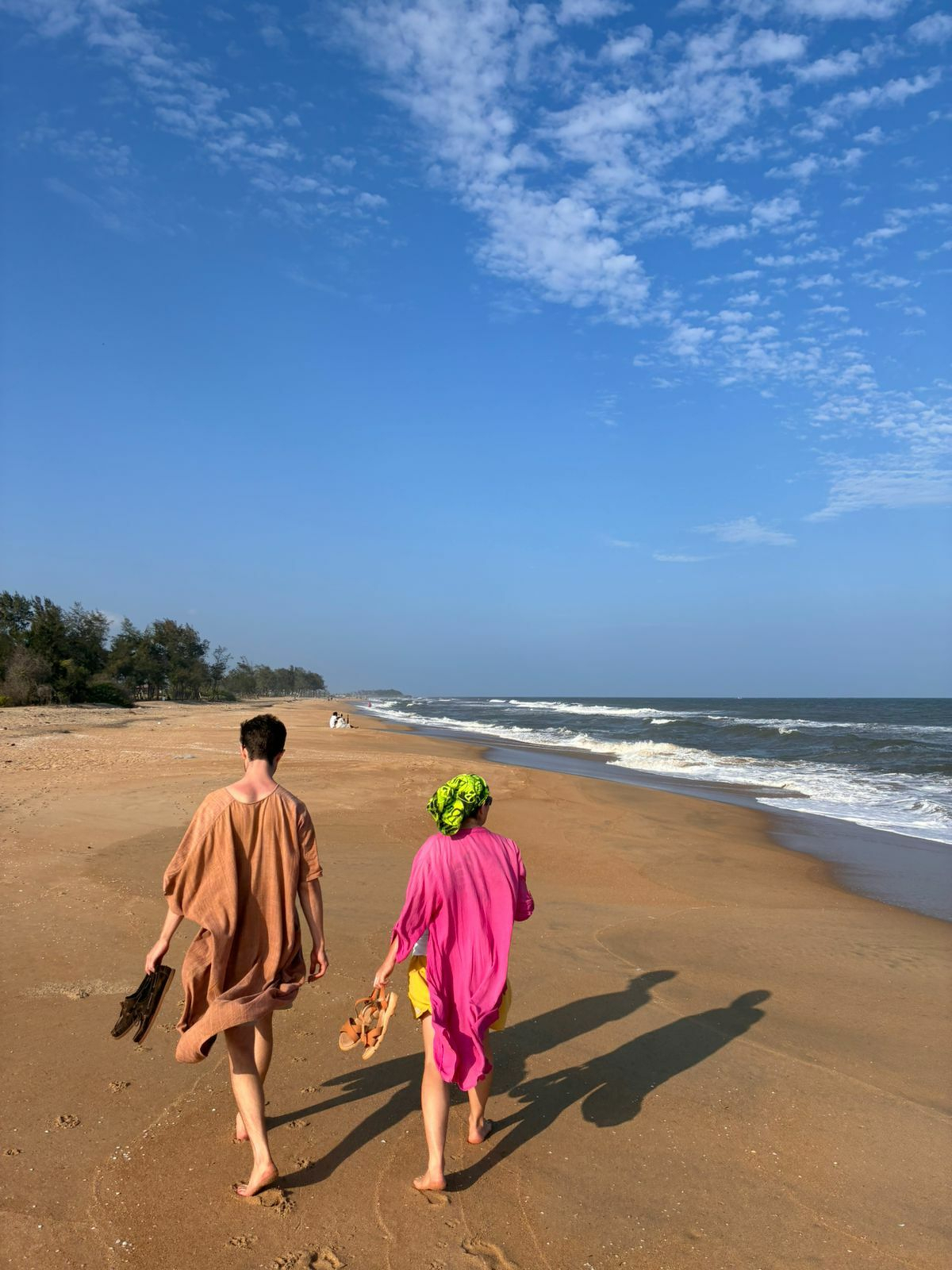
After a few days, Sam joined the two of us. A guy from a place in the south of Tamil Nadu, he is a dentist but came to Auroville to join acting classes. We joined a bonfire singing night and Universal Peace Dances at the Tibetan Pavilion with him. During one of our dinners we made the plan to go to Mahabalipuram. Sam luckily had his car with him, so we drove there. This is a place with loads of temples over 1400 years old. Unfortunately, it was super crowded, and especially Ilona was disappointed by the temples themselves. We had an amazing time hanging out though, we talked a lot about the unborn and sexuality. On the way back we stopped at a beach, where Sam and I took a plunge, and we saw many stranded seaturtles. Before I left Auroville, the three of us had a farewell dinner at the Spot and Catamaran in Pondicherry, where I drank my first beer in a while!
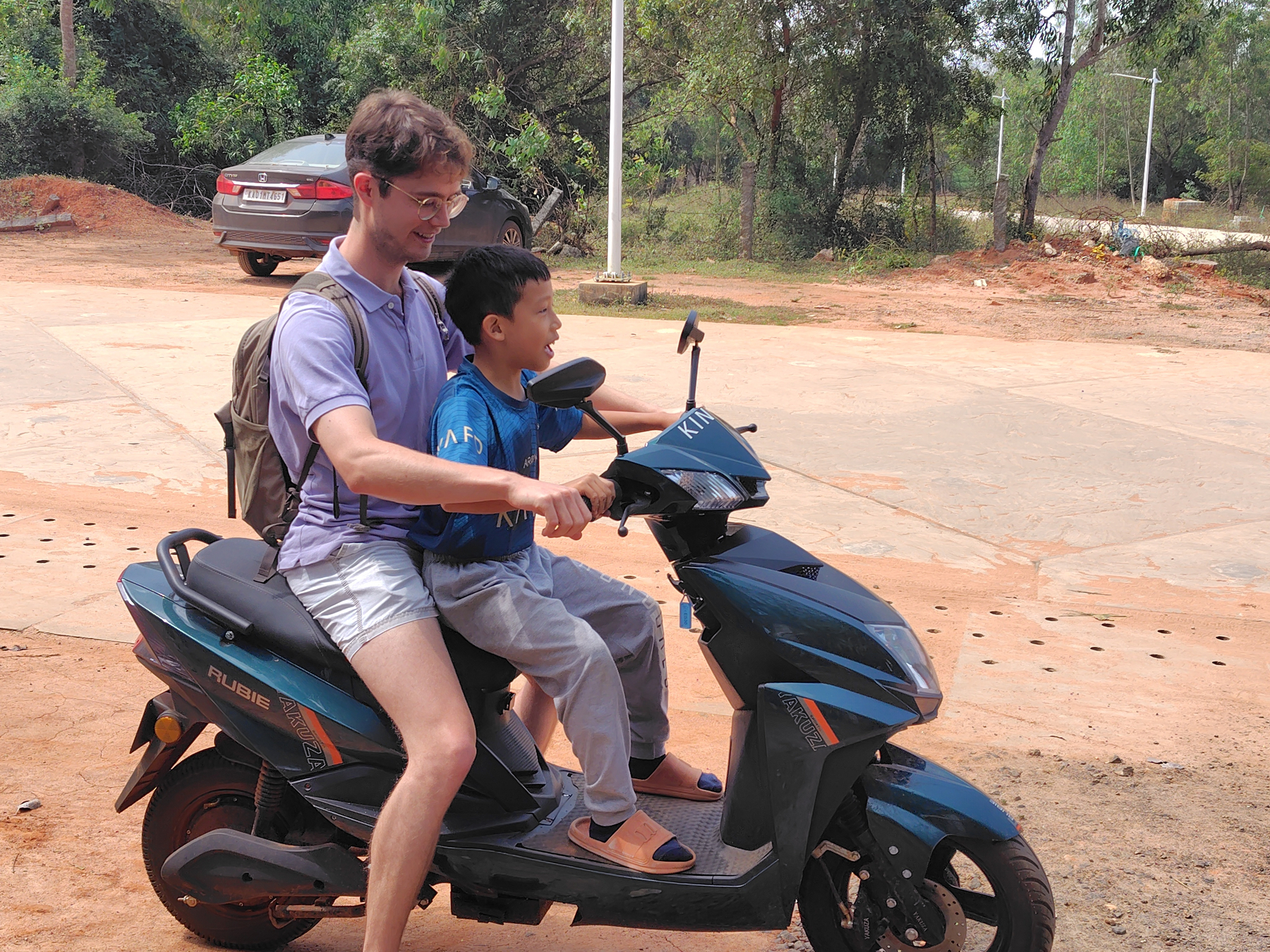
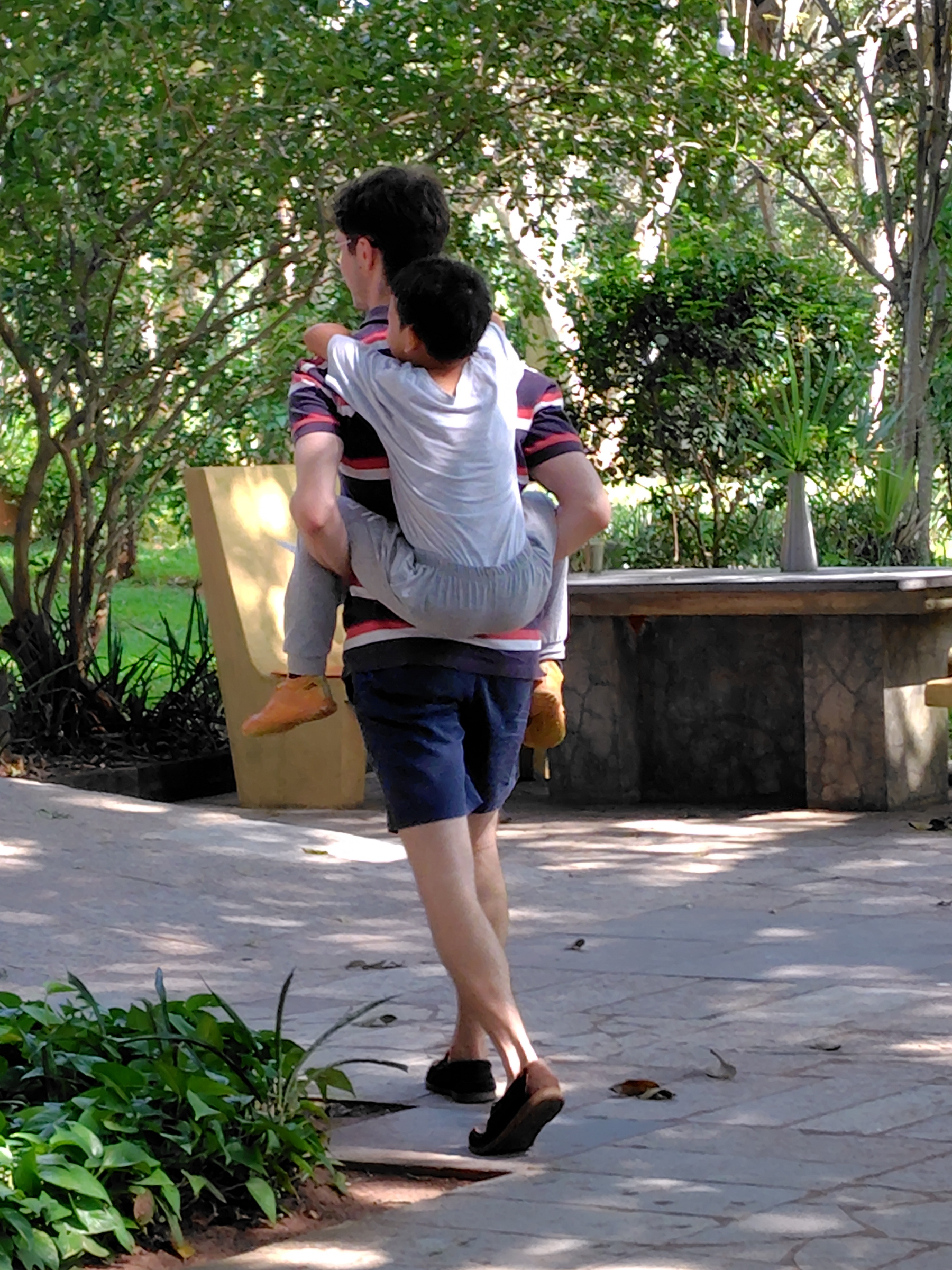
Another character whom I deeply value having met is Shiju. After the debacle with the Tamil teacher at the Language Lab of Auroville, Enzo had mentioned that a volunteer from Taiwan had come, her name was Shiju. Initially, she was simply to help me improve my Mandarin and calligraphy, while I would help her son Kuang with English. I thought this would be a good refreshal for the time I will spend in China (and Japan) soon. But the best thing was that we became friends. I would drive around with Kuang on my scooter in Auroville, and Shiju and I couldn’t stop talking about ideas around filial piety and how they relate to topics like the unborn (a very interesting topic to me hahaha), dementia, or traveling.
It was interesting to talk with specifically her about this because she had gone into the world on her own at age 15, but later came to deeply understand and value Confucius’ idea of filial piety. Now that she had a son, all such questions gained an entirely different light.
I’m also grateful to have met Auro from the World Union Organisation. This is an organisation I research for my PhD, and Auro was so kind to invite me to his home for food and to meet his family and other World Union board members.
Another fellow who left a mark was Anthon, an Austrian guy whom I kept running into at Solar Kitchen. We almost always talked philosophy or ethics, but I loved it. What I appreciated was his analytical rigor and how he did not mind thinking through any hypothetical, but still had a genuine heart to get at a good solution. Though he is a physicist and would describe himself as a utilitarian (a way of thought I could never abide!), he had the wisdom and sincerity of a Russell.
And many other lovely people, like Maja, Ishaan, and Anita, made these last two weeks in Auroville a gift!
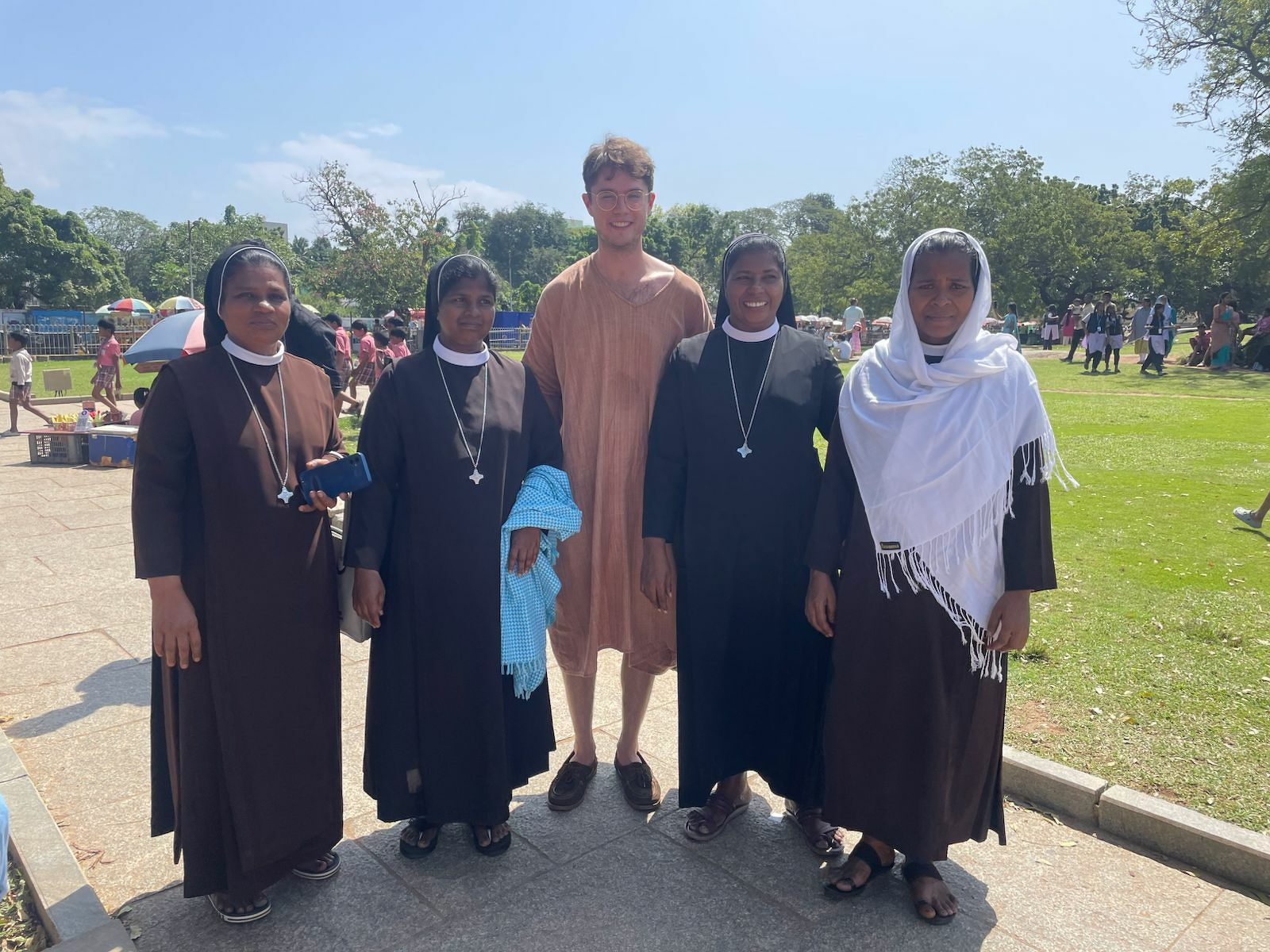



Goddag Letter, Pluk in Scheveningen
This one is for Pluk.
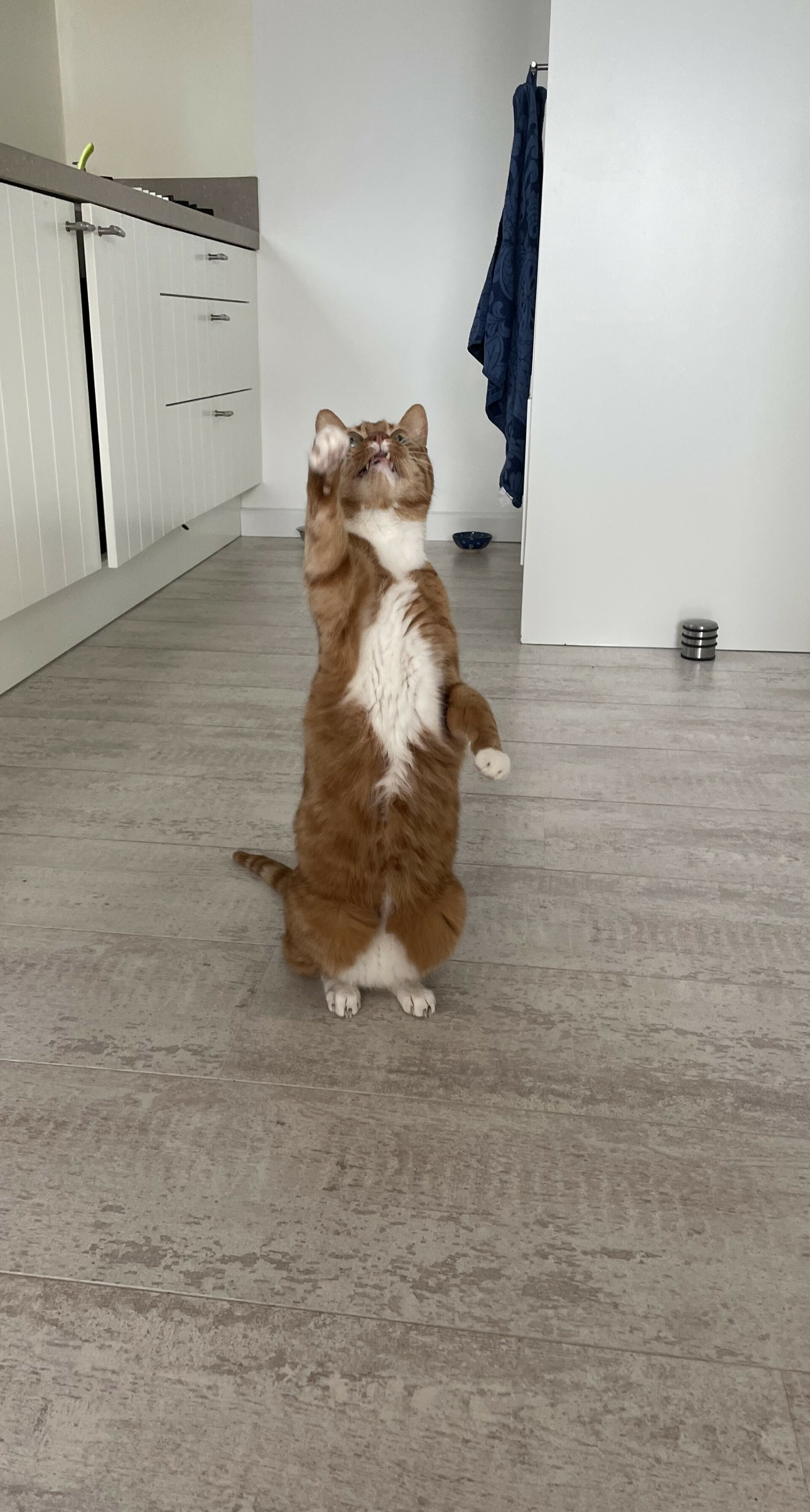
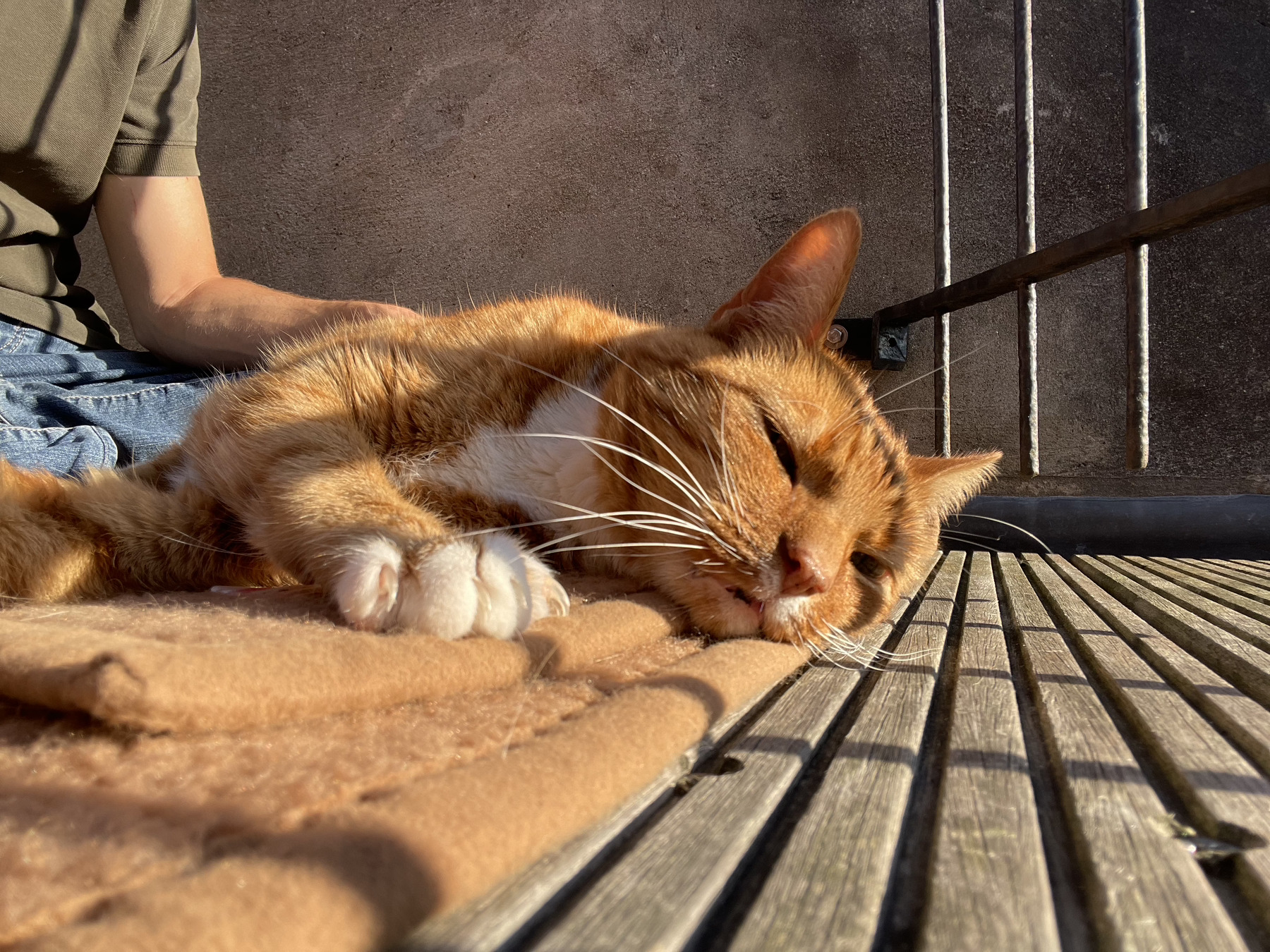
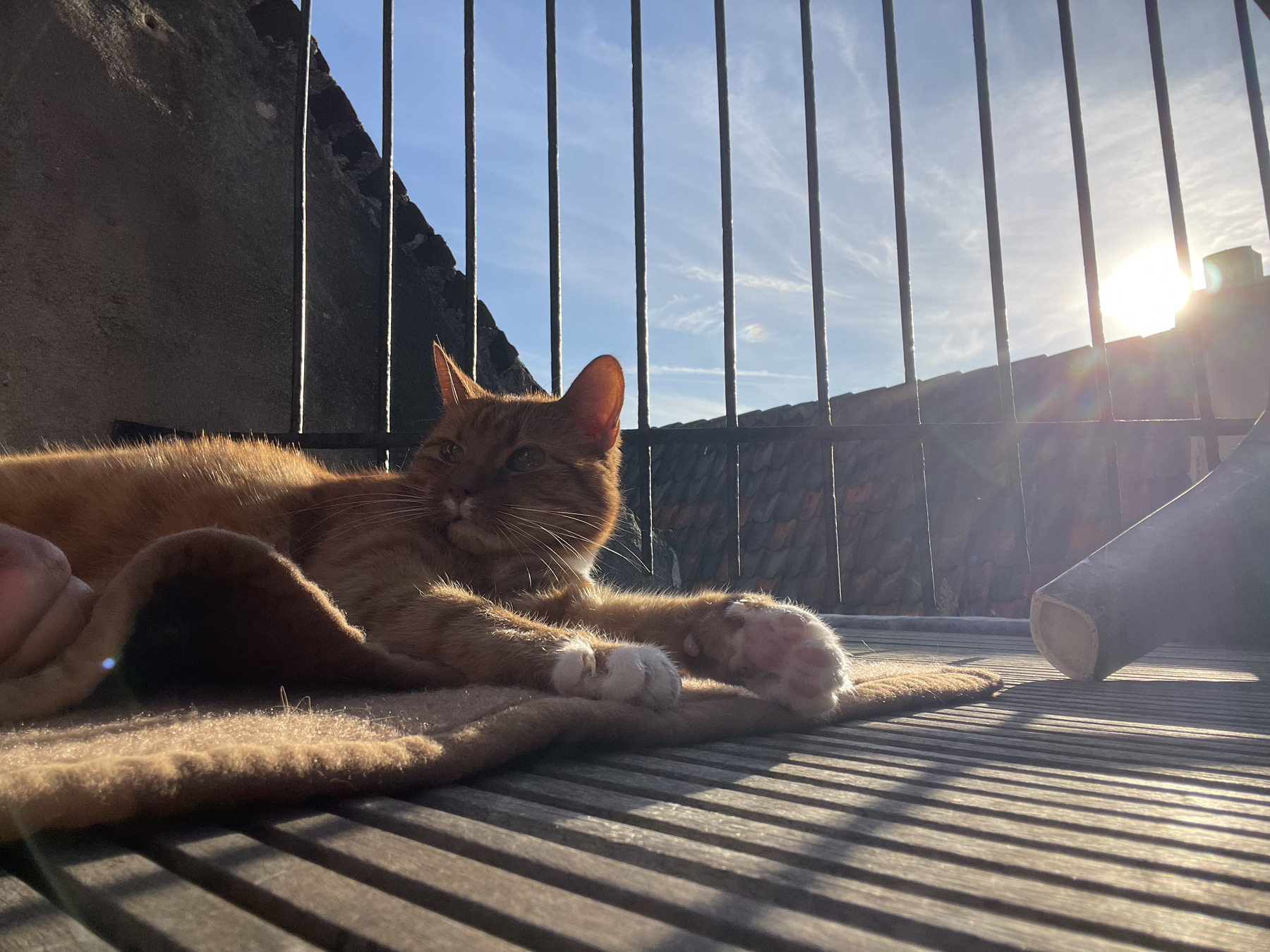
I remember, end September, I sat with Pluk on our balcony in Leiden. He stared into the sky as it was turning dark and starry. Though it could have been any other night, he must have noticed something different… The next morning we left for Scheveningen.
Pluk would stay at Loes in Scheveningen as I was going on fieldwork. In the midst of fireworks and the chaos of the Els Rechts protests my tram was slowly moving towards Loes her house. Pluk was surprisingly at ease with traveling in Public transport, he was just staring out of the window at all the protesters. When we arrived at Loes her apartment, I immediately felt good. Pluk also seemed content.
As usual with Pluk, he had no anxiety about his new place and immediately started exploring every corner. Loes, Roos and I started chatting and we talked the entire afternoon. We had a wonderful time. Pluk alternated between sitting with us and walking around his new home. I was happy to see Pluk so at home. When Loes pulled out her liquid snacks, Pluk hesitated for a moment and then devoured this new favourite treat of his.
From October onwards, as I went on fieldwork, Loes and I kept in touch and exchanged updates. She would write the funniest and sweetest letters from Pluk’s perspective. In response, I would update Pluk and Loes on my fieldwork and share pictures from India.
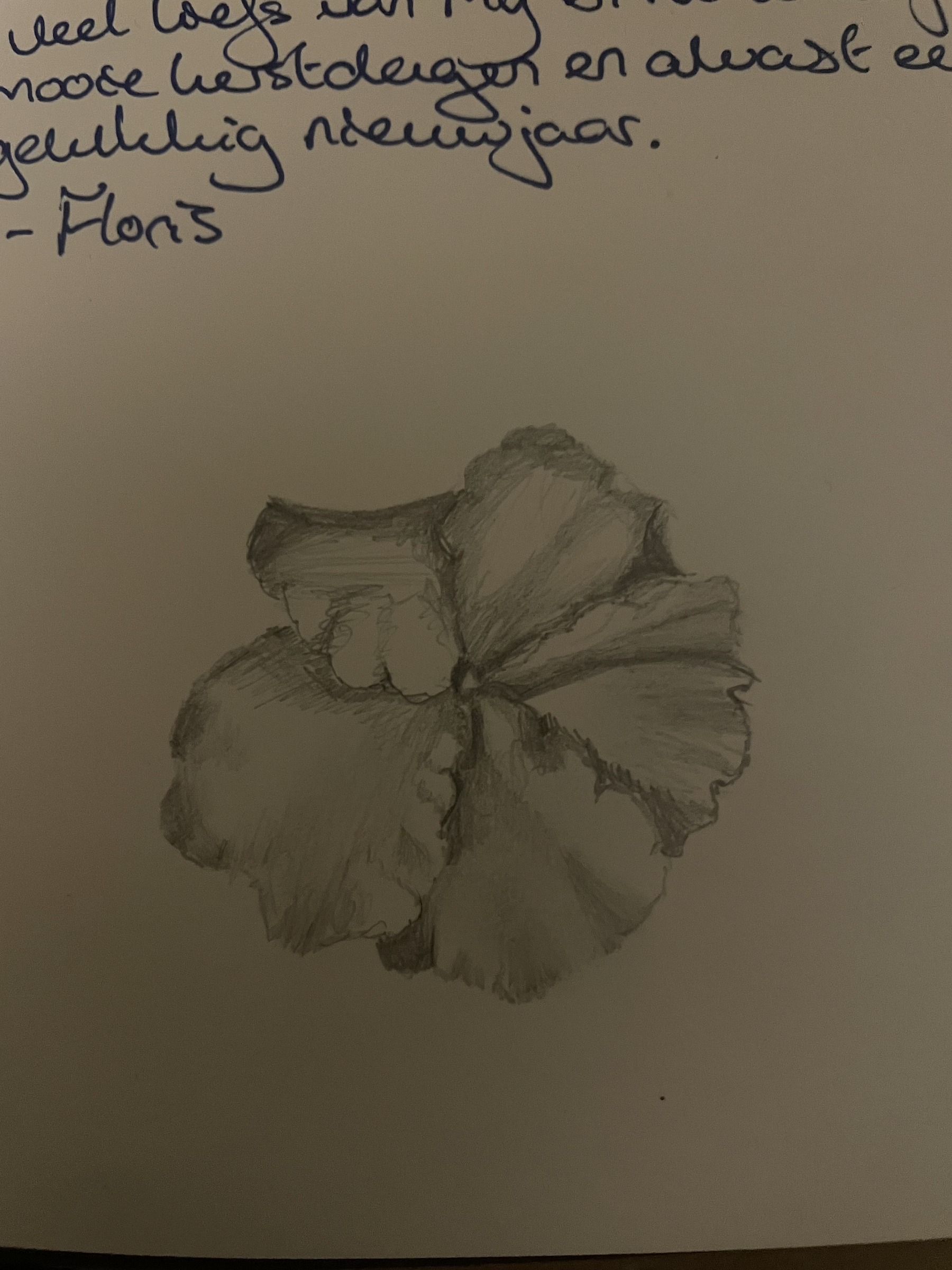
With photos and greetings from Pluk, Loes, and Floris
Goddag Letter #10, Pondicherry, 28 Dec - 09 Jan
New Year’s was amazing. Svaram gave a wonderful performance at the Matrimandir, which I attended with friends I had made over the past weeks in Auroville. Probably the most beautiful New Year’s I have had!
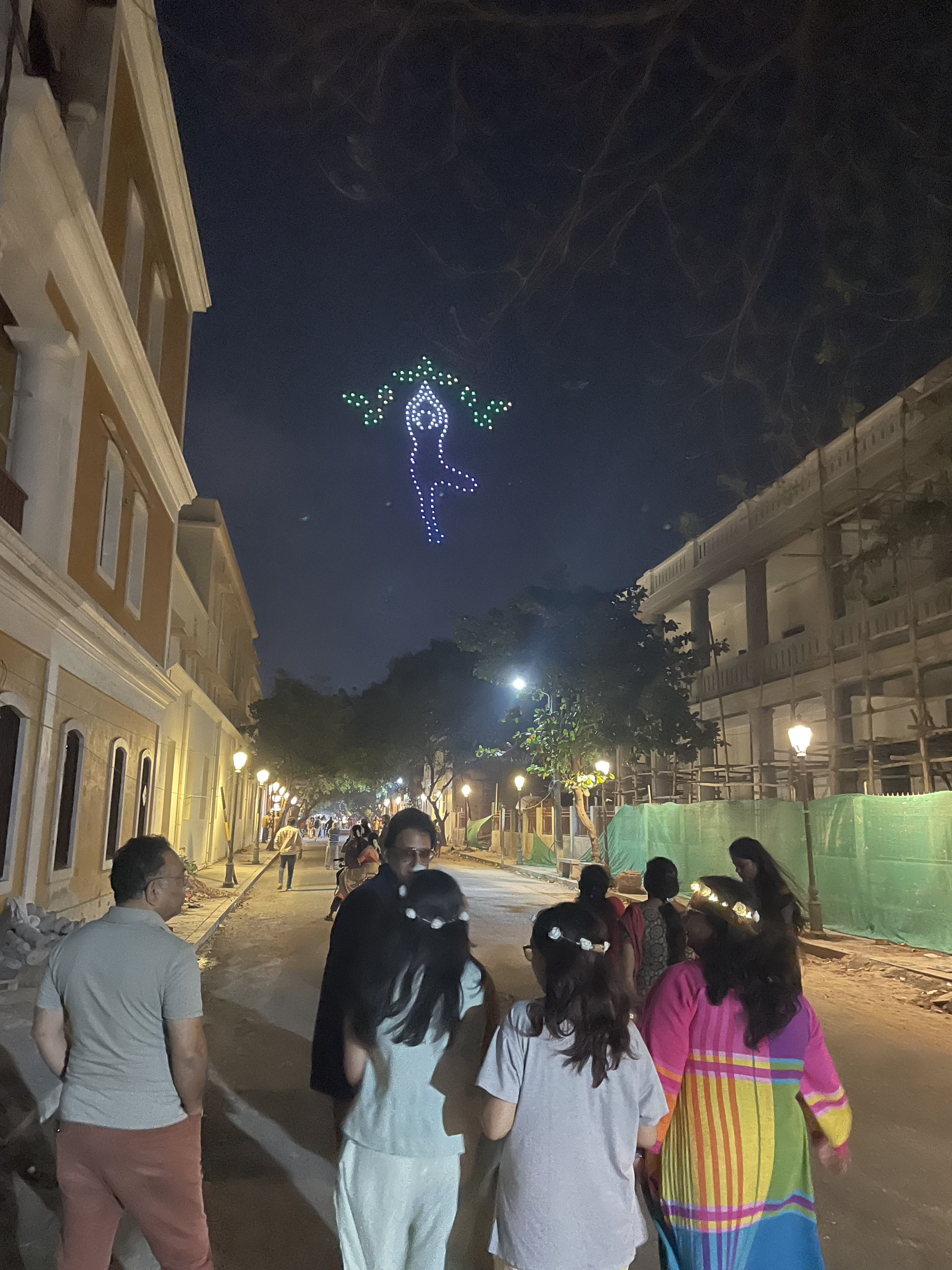
At the start of last week I shifted to the Aurobindo Ashram Park Guest House. A beautiful guest house right next to the ocean. It’s a quiet corner in the loud streets of Pondicherry. Unfortunately, Pondicherry is no longer the sleepy town it was when Aurobindo arrived here in the early 20th century. Nowadays it is mostly domestic tourists posing in front of the colonial French gates for wedding pictures, and restaurants serving “colonial French cuisine”… Still, Pondy retains a lot of its charm for me, I love cycling through the old streets or running at sunrise on Rock Beach. So, on the first few days, I mostly cycled around, got some groceries, and bought Indian ink for calligraphy. The weekend I arrived, the International Yoga Festival was going on in Pondicherry, which meant there were many events and it was quite crowded. After work on Monday, I visited Arikamedu in the afternoon, which I made a separate post about.
At breakfast on Tuesday, I noticed a special and rather expressive lady ordering food in the Dining Hall of Park Guest House. As I tried to eat my breakfast in peace, she suddenly asked me where I was from. She immediately shared that she used to stay in Eindhoven and then asked what I was doing here in Pondicherry. I told her about my PhD topic on the role of certain ashramites in the peace movement, she lightened up and grabbed a book from her bag. As she brushed the dust off the book, I recognised the title Mayayogi by R.R. Diwakar (politician and founder of the Gandhi Peace Foundation). She started talking: “So my grandfather was very involved in the peace movement…” I thought: “She must be joking.” R. R. Diwakar is almost in all the archival material for my research! Then she pulled out several articles featuring her and her grandfather, which confirmed what she was saying: she was Deepti Diwakar, a peace worker herself, Miss India, and a Bharatanatyam dancer.
After breakfast I went to the office of the World Union. An organisation based on Aurobindo’s book Ideal of Human Unity. It had a big presence in international peace work in the 60s and 70s, before internal strife made them mostly inactive later on. Auro Ashish runs the organisation currently, and I had a lovely conversation with him. We talked about the different transformations in Aurobindo’s writings and how to see them next to each other (trigunatita, karma/bhakti/jnana, etc.). He was shocked that I knew details behind the history of the World Union, and he even wanted to propose me as an honorary member!
After some lunch at Suguru Spot, I went to the Aurobindo Ashram Archives and bumped into a German girl researching her family roots in Pondi. We had a chat. Afterwards, Heehs and I went through the Ashram Archive catalogue in search of correspondence and files on peace workers.
Wednesday and Friday, I drove to Auroville on my scooter. If you ever happen to travel between Pondy and Auroville, I strongly recommend driving on the old Auroville Road, it makes the journey a hundred times more pleasant than on the ECR. I met up with Shiju, and for lunch, I had agreed with Robert, another PhDer writing on “British Hippies”, to eat at Sudha’s Kitchen, which was fun!
Still, I’ve found rather little time to really be part of the ashram life in Pondicherry itself. There simply remains little time in a day because of Auroville and the archives… Instead, whenever I find some private time, I am currently reading Kierkegaard’s The Present Age. One of my favourite quotes that critiques our current attitude is this one:
“A passionate tumultuous age will overthrow everything, pull everything down; but a revolutionary age, that is at the same time reflective and passionless, transforms that expression of strength into a feat of dialectics: it leaves everything standing but cunningly empties it of significance. Instead of culminating in a rebellion it reduces the inward reality of all relationships to a reflective tension which leaves everything standing but makes the whole of life ambiguous: so that everything continues to exist factually by a dialectical deceit, privatissime, it supplies a secret interpretation - that it does not exist.”
P.S.: Only one photo of beautiful Pondicherry attached to this post?! I’m working on it… The photos I’ve taken of the stunning old streets of Pondicherry are on my TLR. But next week is Pongal, and I’ll take more casual photos of Pondy then, too.
Unearth Kāla #5, Arikamedu an Indo-Roman Trading Port?
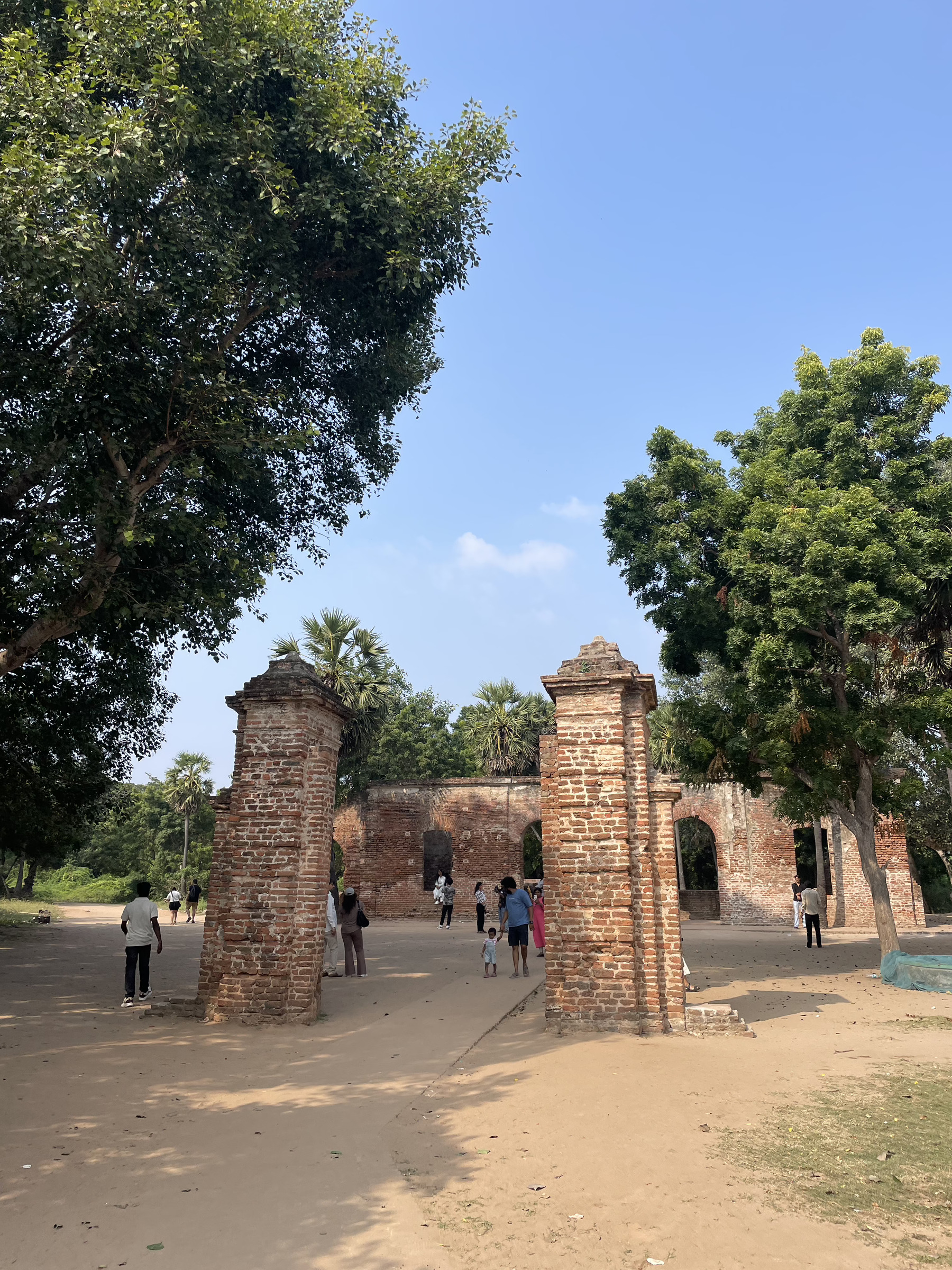
After my workday today, I went on my bicycle to Arikamedu. I’d been told this was the famous Indo-Roman port on the east coast. In the 1940s, excavations by Wheeler uncovered a lot of pottery, jewelry, and beads, indicating extensive trade with the Roman Empire. Journal articles from the time hailed this as the decisive identification of the ancient Poduca or Poduke mentioned in The Periplus of the Erythraean Sea and in Ptolemy’s work (see, for example, archive.org/details/i… , you can find Poduke on p. 8, and Poduca on the map at the end, the Periplus is easier to find yourself).
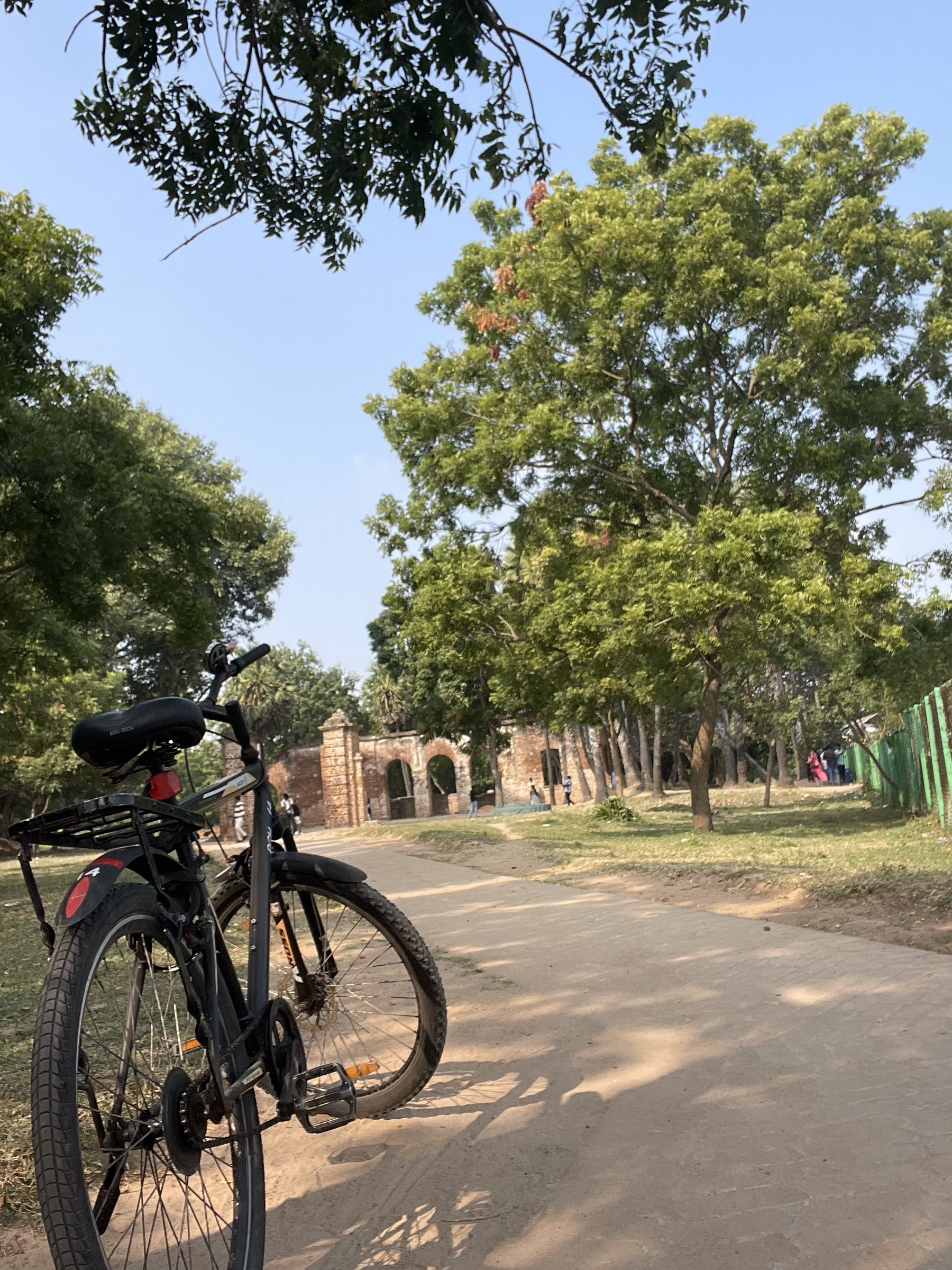
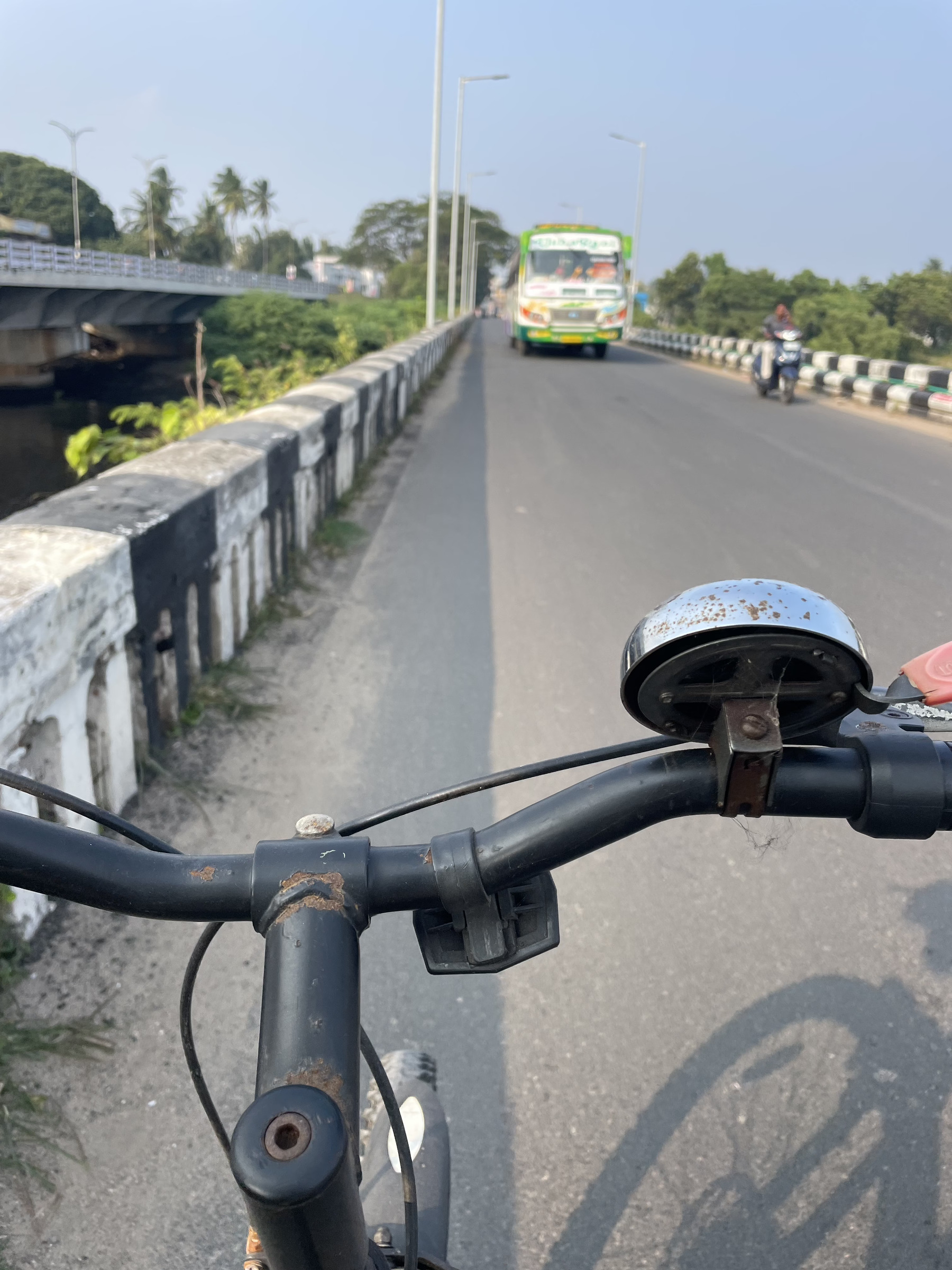
The bicycle ride there was quite nice: sunny, with the wind blowing through my blouse. The only thing that bothered me, of course, were the massive buses and trucks that would honk and rush by at a hair’s distance! See my picture for one of these approaching me.
Many visitors to Arikamedu confuse the current ruins with the Indo-Roman port town. As I understand it, these 18th-century red brick ruins are the remains of a French Mission House. Starting from the “French Mission House,” Wheeler began his excavations, which were later continued by others in the 1940s and 1980s. After the first set of excavations, the large number of Roman-influenced crafts convinced archaeologists that this must be the ancient Poduca. P. Z. Pattabiramin concluded quite triumphantly in 1945: “How really happy we are to have found back the town of Poduke which had a Roman factory in the territory of Pondicherry [sic].” (P. Z. Pattabiramin, Proceedings of the Indian History Congress, Arikamedu Excavation, 1945).
When I find time this week, I’ll go and see the excavated material at the Pondicherry Museum, after which I’ll edit this post. For now, though, the link between these ancient texts and maps and the excavations of the 1940s feels a bit hasty to me. In Pondicherry, it is commonly held as fact that Arikamedu (rather than, say, Pulicat, which some scholars have leaned toward) must be the Poduca of the Geographia or the Periplus. This feels more like an inference than an established fact. Still, the excavations are wonderful, and the revealed historical links of a trade network that probably lasted from the 2nd century BCE to perhaps even the 1800s are amazing. Fortunately, research showing a broadening period of trade activity at Arikamedu keeps expanding, and the link to the ancient trading port of Poduca is made more cautiously.
In the mangrove forest right next to the excavation site, I found these really funny crabs. They’re fiddler crabs. Some mangrove ecologists consider them ecosystem engineers. For example, their little tunnels are thought to be crucial for soil oxygen levels and water infiltration for mangrove tree roots. The male fiddler crab is especially funny to me because he has this lopsided, single giant claw, while the other claw is normal-sized. They wave it in their own rhythm: to impress the ladies, threaten other males, or get rid of excess body heat. There’s a funny article in BioScience about an urban myth surrounding the fiddler crab’s giant claw, you can read it here: academic.oup.com/bioscienc…

Goddag Letter #9, Chinese Calligraphy and Bone Inscriptions , 2 Jan
Hei, god dag,
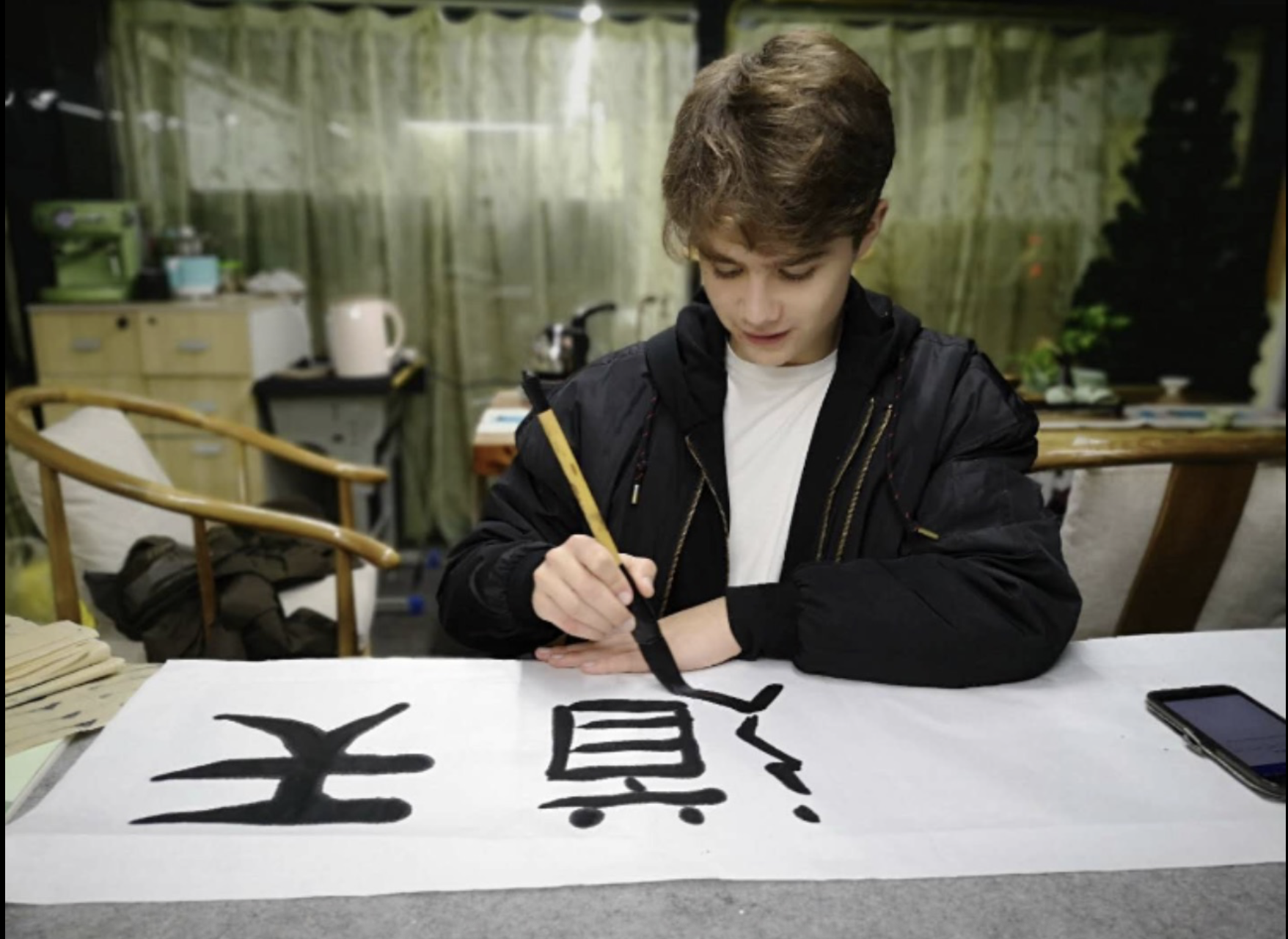
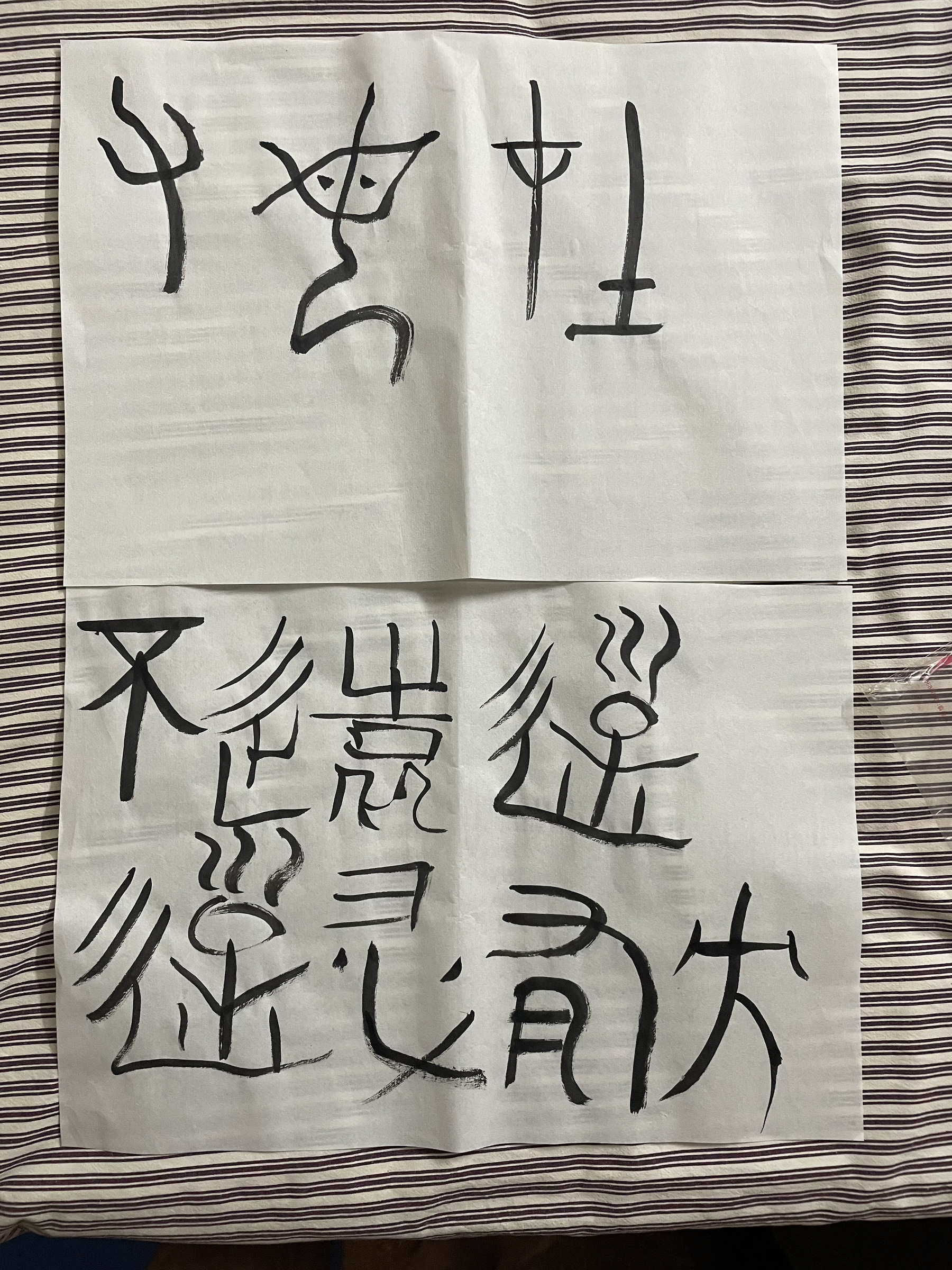
In the fall of 2018, I was sitting in an atelier tucked away in one of the small alleyways of Suzhou, China. There, I calligraphed a phrase into bamboo paper. Despite taking calligraphy classes at Suzhou University, it was amateurish, as a keen eye will spot in the first picture…
More than seven years later, I ran into Shiju in Auroville, who proposed teaching me calligraphy. When she heard I had already learned some in Suzhou, she was overjoyed.
The phrase she proposed to calligraph first was one of the famous lines of the Analects, Book 4: 父母在, 不远游, 游必有方. The meaning of this phrase can be interpreted as follows: When your parents live, don’t travel far; if you travel, have a direction. As I was painting the characters, a sudden wave of emotion ran over me: When I wanted to leave the Netherlands for China in 2018, a plan, a direction, was a firm condition for going so far from home. The entire phrase brings together the complex balance I feel between filial love, piety, and spreading one’s wings. :)
Shiju also taught me the respective bone inscriptions. These cracked me up. This little guy reflecting the bone inscription of 游 seems to be taking a shower in the rain…
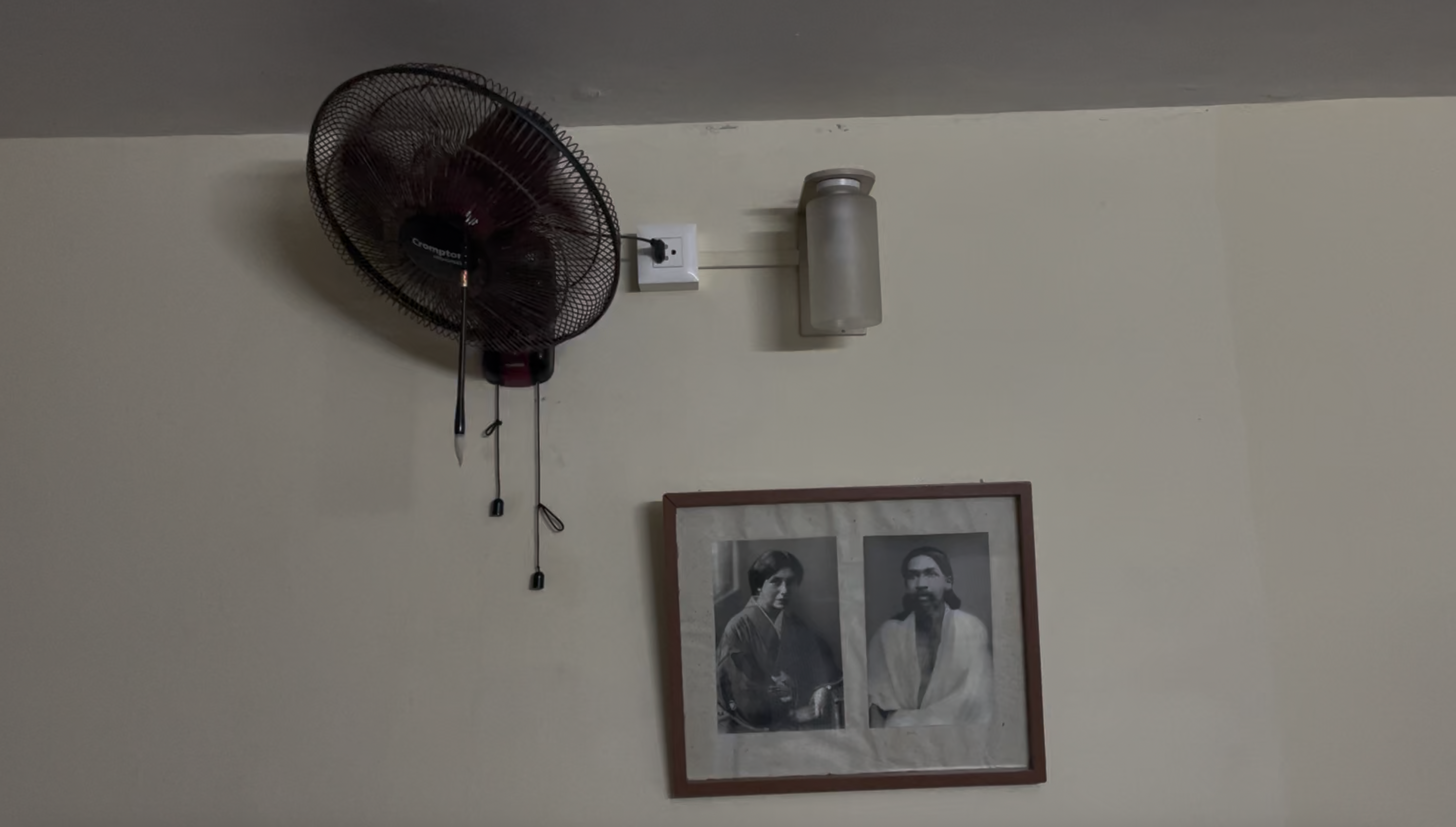
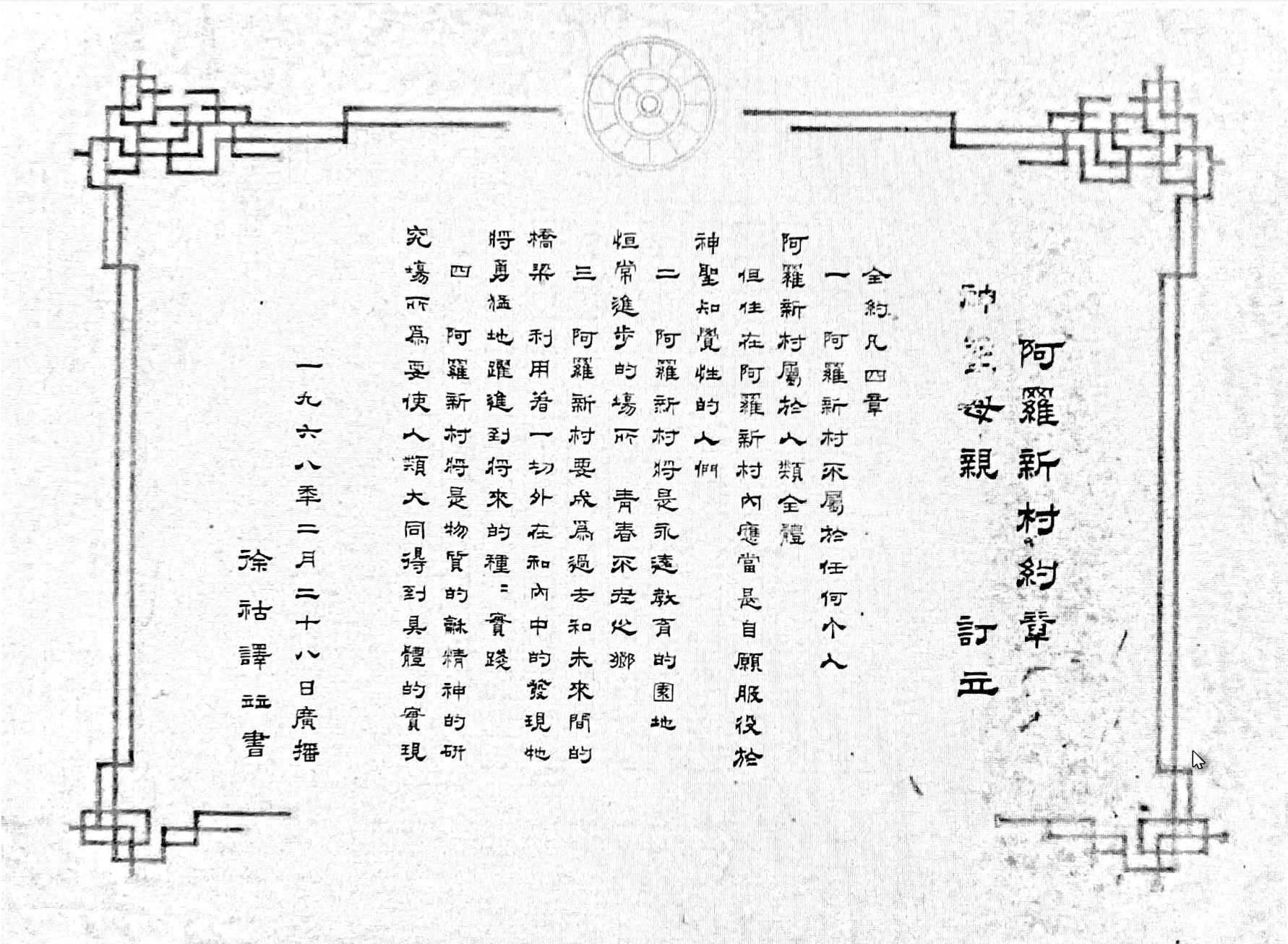
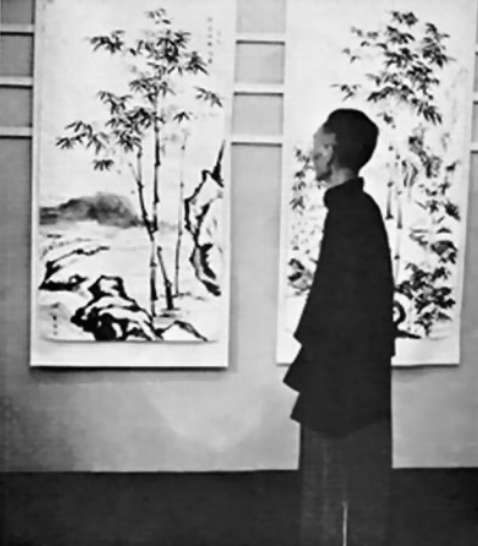
On the fourth picture I am drying my ink brush on the fan. The last two pictures are of Xu Fancheng, or Hu Hsu, a Chinese translator who lived at the Ashram and translated the Auroville charter into Chinese. I hope that one day my ink drawings might reach his standard!

Goddag Letter #8, 22 - 28 December, Cow Escape, Egg Explosion, and Tamil Genius?
I was cycling down Auroville when suddenly a cow jumped out of a home. She was dragging a long rope with her, which had a log and branches attached to it at the end. In all her panic, she had multiple autos and scooters almost drive into her. I stopped my bicycle and, without any conversation, a stranger and I unanimously made it our mission to help the cow to her freedom. While I tried to calm down the cow, the girl screamed to a family next door to get a knife for us to cut the rope with. Failing to cut it with her pair of scissors, we finally cut off the rope with the log using the knife. When this was done, the girl and I thanked each other and went our own ways. As I cycled on, I tried to grasp what had just happened. The cow was severely malnourished, and the situation with the rope plus log made cutting it an obvious choice. At the same time, freedom will probably mean eating trash from the roadsides…
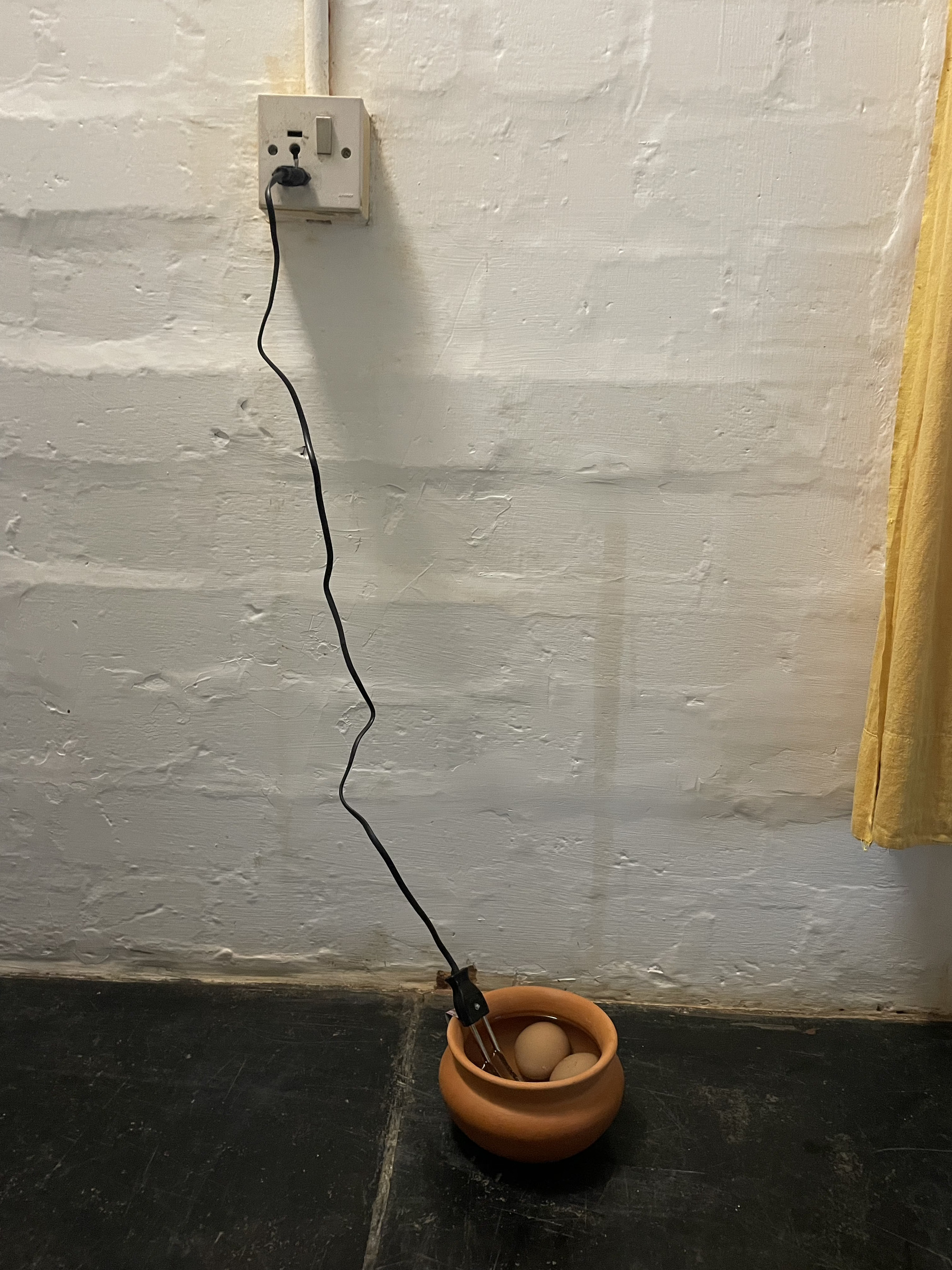
At the end of Auroville Road, I bought a DIY kettle, as they weren’t selling proper kettles anywhere. Basically, it’s only two rods heating water. It is exactly as dangerous as it sounds. That evening I came back to trying to boil my eggs with it, and instead the DIY kettle had exploded from the plug, leaving a suspicious dark silver dust behind it.
Though Monday wasn’t too eventful besides a wonderful lunch with some born-and-raised Aurovilians, Tuesday was truly out of the ordinary. I had my second class of Tamil in the morning. While I already had a bit of a weird feeling about the first class, in this second class something happened which I could have never thought up. The Tamil teacher seriously believed that I was fluent in Tamil and was trying to “play games” with him: the speed at which I was comprehending Tamil was simply not possible for a complete beginner. At first I tried to work with him and explain that I truly did not know any Tamil. But after some time it became clear to me that this was not going to work. We went to the head of the department and explained the situation. However, as we were both trying to explain our sides of the story, a tourist from the North of India walked into the room. Since he was on his phone and asking admittedly quite silly questions, the Tamil teacher became mad at him. When their fight subsided, the main administrator concluded that the Tamil teacher was not having a good day and that we were not a match. Since the other two Tamil teachers were fully booked for the next week, we decided that instead I could take classes with the Mandarin teacher to further improve my Mandarin. Shiju is the most amazing teacher, and I also give her son some English lessons in return.
When I got out of the language school, I was quite confused and upset by the whole situation. Though the upside was that I could consider myself a Tamil genius, I still disliked the entire interaction and false accusation. Before I could head back to the archives, I sat in the forest to recollect my mind. Then I had lunch at GOYO, a Korean lunch place. They have the best Korean food ever; she makes everything herself and even picks some of the vegetables from the mountains. The point of lunch there is that you eat it in silence: GOYO. When my stomach was full, I headed to the archives, worked for a few hours, and finished my day with a gym workout at Dehashakti. That day I realized how much I value having my community at the place that I am staying. Since we always eat dinner together in the guest house, it helped me process this eventful day by chatting with others about it.
On the day of Christmas Eve, I did archival work, went to a sound immersion at Unity Pavilion, and finished the day with another wonderful dinner and a long Christmas call with my family. On the days of Christmas, I hung out with friends and went to Sadhana Forest, which has its own update. Then, at the end of the week, I was at Matrimandir, and we attended a concert in Auroville on Saturday. The musicians were combining electronic soundscapes with a guy playing quite good violin!
Quotes I recently read:
“When we speak indeed of the errors of Nature, we use a figure illegitimately borrowed from our human psychology” and “What the practical man of today denies as absurd and impracticable is often enough precisely the thing that future generations set about realizing and eventually in some form or another succeed in bringing into effective existence” (Aurobindo, The Ideal of Human Unity)
“Self-love is not so vile a sin as self-neglecting” (Shakespeare, I think Henry V)
“As an older person, in relation to a child, can press its claim to such an extreme that it ends by actually weakening the mind … so also the Eternal can, in the imagination of an excitable person, make an attempt to push the temporal into madness” (Kierkegaard, Purity of Heart)